
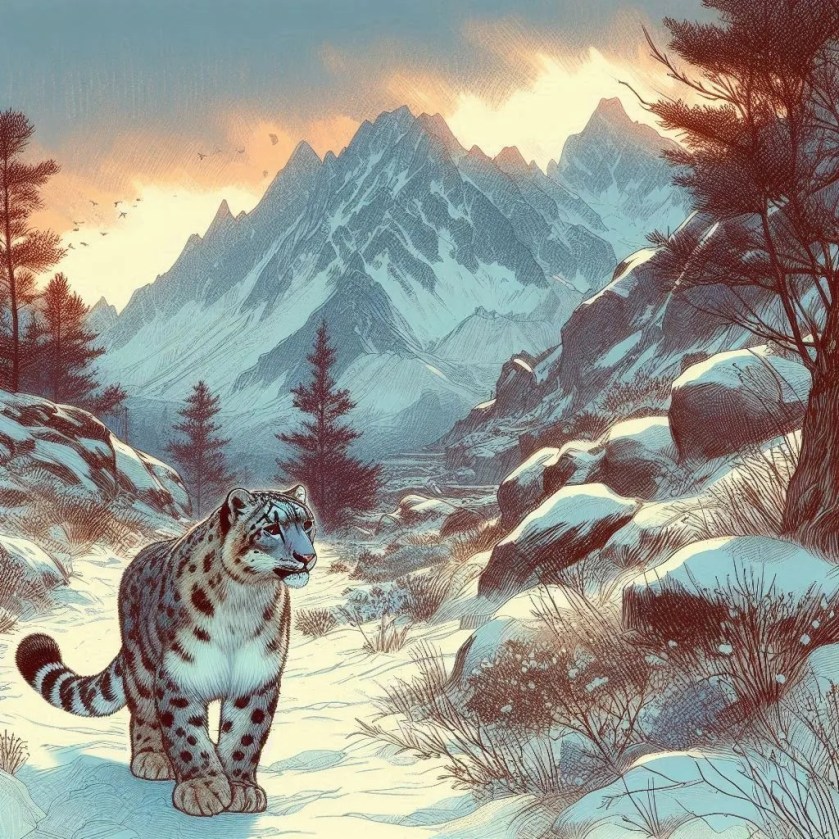


This short story is something I came up with for fellow blogger Kevin’s No Theme Thursday post for this past week. Kevin, glad you’re back from your NTT hiatus! Always enjoy picking something from your amazing collection 🙂

The sun was setting in the west; soon, it would be behind the mountains, leaving the valley in twilight. The temperature would drop quickly as the winds blew down from the 15,000-ft snowy passes.
My client stopped to adjust his pack. He looked at me; ice was on his face under his eyes and nose, and his breath made clouds in the frigid air. “Do you think we should make camp soon?” he asked.
We were completely exposed to the biting winds. A mile or two ahead was a much better spot, ringed on three sides by steep rock walls with a natural spring nearby.
“No, we keep going,” I said. I turned and continued on. The American followed.
We had been on the trail for four days now and the conditions so far had held. We’d be in Bhūta’s territory by midday tomorrow and we’d need to proceed much more slowly, cautiously. It was his realm and he was aware of everything; but in particular, of humans.
###
Within 30 minutes, we arrived and entered the tiny canyon. While I went to fetch water, the American unshouldered his backpack and stretched painfully. Then he began to pull out the rods for our tent.
My feet crunched in the snow as I walked. It was nice to be alone with my thoughts although they were accusatory. My heart was not in this trip even though I was being paid ten times what I usually received as a guide for backpackers. If and when we found Bhūta was a time I was dreading.
I had heard about him since I was a youngster. The elders in our Nepalese village told stories and legends: Some said he was immortal; others said that he could shift-shape into different forms. I’d seen him only once in my life and one thing was certain; he was huge, at least seven feet long and probably close to 200 lbs.
I saw his footprints in the snow sometimes and they were the size of dinner plates. I saw gashes in the trees where he sharpened his claws and I was astonished at how high he could reach. I half-believed the stories.
I took off my glove and put the canteens under the tiny spring. As they filled, I considered the American.
He was a wealthy executive of some multinational corporation. He worked in New York but his home was in Montana. His passion was big game hunting and evidently the walls of his living room were lined with species from around the world. Not all were legal; perhaps those guides had also been pain ten times their usual fee. My conscience pricked me, but I needed the money for my family.
Back at camp, the American had the tent up and was gathering wood for a fire. He looked at me. “Do you think we’ll see him in the morning?” he asked. He struck a match and lit some twigs. He leaned over and slowly blew on them.
“Hard to say. Maybe.”
After we ate, the American took his rifle out of its case. It was a large caliber model with a telescopic site. He took a cloth from the case and slowly polished the gleaming barrel and wood stock. One thing I liked about him, he didn’t talk much.
We finished dinner, put out the fire and got into our sleeping bags inside the tent. I was asleep within a minute.
###
In the morning, I awoke first. I put on my coat and outerwear as my client rose and did likewise. I finished first and zipped up the tent flap, intending to go start a fire. I was halfway out and stopped short. The American, directly behind me, collided with me.
“What is it?” he asked. “Why did you stop?”
I opened both tent flaps. The American gasped. Outside our tent, no more than two feet away, were dinner plate-sized tracks in the snow. Bhūta.
We looked at each other, wide eyed. “Good Lord,” the American said softly.
###
After breakfast, we broke camp and continued on. We were not yet inside Bhūta’s territory; I was wondering what he was doing so far away. But he could be anywhere. We both proceeded with extreme caution.
The sun climbed and reached its zenith. We stopped for lunch. As we ate, the American looked at me. “Are we in its range yet?” I felt irritated; I felt like telling him it was not an it; he was Bhūta. But I held my tongue and simply nodded. The American nodded in satisfaction and continued eating his freeze-dried stew.
An hour later, we started seeing trees with claw marks and our pace became even more deliberate. I noticed the American looking at the tops of nearby rock formations. He stopped, reached into his pack and pulled out a pair of binoculars. In the afternoon sun, he slowly panned the ridge line. He spoke as he looked. “I’m thinking he—“
He was cut off by a roar. It was everywhere at once, echoing off rocks and ice. He could have been ten feet away or three hundred. The hair on the back of my neck stood up and my legs felt weak. Apparently it had the same effect on the American who looked around wildly, expecting a 200-lb snow leopard to come flying off a rocky overhang.
After a minute, with nothing, the American reached into his pack, and removed his rifle. He looked at me. “I think it’s time for this, don’t you?” I nodded and let him lead.
###
As afternoon wore on, we entered the heart of Bhūta’s territory. The path continued to rise and became more narrow and rocky. In some places, there was a sheer drop of hundreds of feet. We walked single file, both of us swiveling our heads, ears straining for the slightest sound.
The American turned and started to speak over his shoulder. An instant too late, I saw the gleam at his feet; the frozen runoff of a spring across the path. His feet slipped and he fell headlong onto the rocky path. His face hit the ground and his rifle fell from his grasp. It went over the edge; I saw it falling, clattering, end over end, until it was lost in the deepening afternoon shadows.
He looked up, his forehead bleeding profusely. We both understood the situation.
The hunters were now the hunted.
###
Heading back, we moved as quickly as possible while still keeping a sharp lookout. The American’s forehead was split; he’d need stitches and medical care as soon as possible.
We made camp for the night, sleeping in the same protected space we did during our ascent.
The next morning, the tent was flapping as the wind blew. I stuck my head out and saw nothing but white. Snow was flying almost horizontally in the blizzard. If we weren’t in a protected spot, the tent would have blown away.
The storm lasted two days without let-up, the wind howling and the snow pelting the tent. We stayed in our sleeping bags unless we were getting food from out backpacks. Our supplies were almost gone.
Twice more, during the storm, we heard Bhūta’s roar. It was impossible to know where he was or how far away. I saw the American folding his hands and silently speaking.
On the third morning, the sky was clear again and the sun was out. The snow was deep. We broke camp as quickly as possible. I took a close look at the American’s forehead; it didn’t look good. The gash, which was still oozing, was black around the edges. Angry red streaks led back toward his hairline and disappeared under his stocking cap.
“I… I don’t feel so good,” he said quietly. “Feel hot. Dizzy.” I held a hand to the back of his neck; he was burning up. We shouldered our packs and crunched our way through the knee-deep snow on the trail.
We turned a blind corner–and sitting on the path in front of us, not twenty feet away–was Bhūta. I’d never seen such a magnificent animal. He didn’t move, didn’t flinch, just held our gaze with intense blue eyes that shone with otherworldly intelligence.
He wasn’t just looking at us, it was more; it was though he was inside my mind, reading my thoughts, critiquing me somehow. Some transcendent question was being asked, and he was searching for answers.
I risked a slight glance to my right; the American also seemed transfixed.
Bhūta roared. It was deafening. He raised a massive paw although his claws were sheathed. He held it up for several seconds, gently boxing the air the way house cats do. Then he issued another sound, different, softer; a mewling thrum.
He gazed at the American and there was some exchange. He sat and removed his stocking cap. Bhūta approached, sniffed his forehead and scalp, He gently licked him several times.
Then with incredible swiftness, he turned and vanished. It was not possible for an animal his size to move that quickly. Yet he was gone. No tracks, no falling snow from branches or rocks, no noise. Just…gone. The American and I stared at each other. Did that really just happen?
Back in Pokhara, I got him to a hospital. The doctor told me that somehow there was no infection; he was mystified. He put in a dozen stitches and kept him overnight for observation.
I went to see him the next day. His head was bandaged and he sat on the edge of his bed.
“I don’t know what happened out there,” he said softly. “All I know is… something changed. In me. I…I see things differently now.” He raised his eyes and met mine. “I’m a different man, Kiran.”
###
After he went home, we kept in touch. He removed all the stuffed heads from his house. He sent me a newspaper article; he had quit his job and established a global conservation organization. He asked me to head the Snow Leopard program. I shut down all hunting.
That was all twenty years ago; and snow leopards rarely live longer than ten in the wild.
Yet I still see his tracks.
 My little corner of the world
Darryl,
I am not blowing smoke in the least when I say that you have a magnificent way with words, my friend. Your stories always pull me in and always bring out an emotional reaction of some sort. Truly, truly exceptional, and I mean that. Thank you.
LikeLiked by 2 people
Thanks, Kevin! Your pix always get my mind spinning…there’s a story here, just gotta find it 😉
LikeLiked by 1 person
Well, thus far, you have succeeded magnificently. Always a pleasure!
LikeLiked by 1 person
Another exceptional piece, Darryl!
LikeLiked by 2 people
Thanks, Terry! Always appreciate you taking the time to read my stories 😎
LikeLiked by 1 person
This is wonderful!
LikeLiked by 2 people
Thanks, Ian! Appreciate the kind words and you reading it 😎
LikeLiked by 1 person
It was a good story! I enjoyed it! Credit, where credit is due!
LikeLike
I felt cold while reading this, which isn’t easy in Miami. So descriptive and thwarted my expectations of a gruesome fate for the American.
LikeLiked by 3 people
Thanks, Stephanie! I did consider a different fate, but was a softie 😎
LikeLiked by 2 people
Nice to catch sighting of a rare change of heart!
LikeLiked by 3 people
Very entertaining, Darryl.
LikeLiked by 2 people
Thanks, Mary 😎
LikeLiked by 1 person
What an interesting story, love Kevin’s NTT prompts and your share with this one.
LikeLiked by 2 people
Thanks, Pooja! Hope you’re doing ok (?)
LikeLiked by 2 people
I’m much better now, thanks.
LikeLiked by 1 person
Excellent story!
LikeLiked by 4 people
Thanks, Dawn! Appreciate you reading and the kind words 😎
LikeLiked by 1 person
That I couldn’t tell while reading if it was fact or fiction ~ yet remained mesmerized throughout ~ testifies to your excellence as a story teller!
I also found a number of parallels in it to my own real life, only in my case it was black bears ~ one of which was also impossibly large for the breed, and the other of which disappeared exactly as you have described ~ who came that close to me, and even much closer.
If you wish to read more about those adventures they are available via my site’s search bar ~ ask for “Tail of the Bear.”
Great read 👌
LikeLiked by 1 person